

Graphene and anyon physics

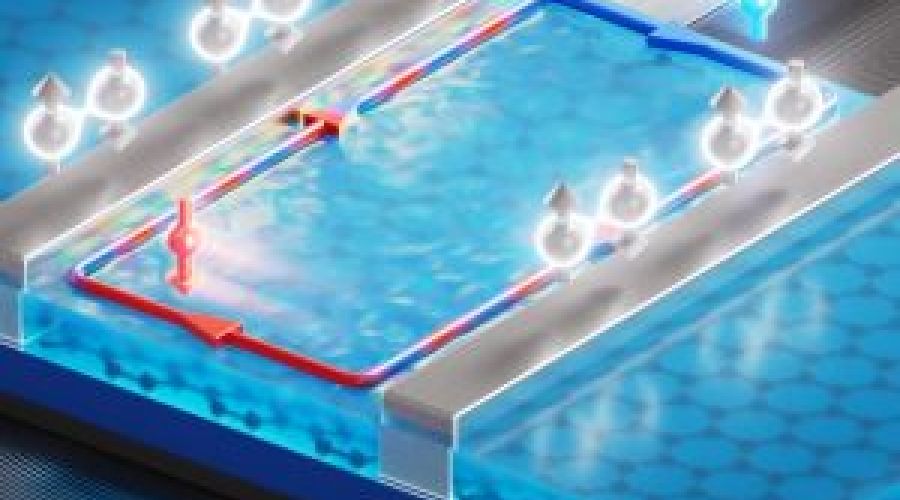
We build and study quantum Hall electron-optics architectures in graphene that span chiral and helical edges and interaction-driven phases in the zeroth Landau level. By engineering the quantum Hall topological insulator (QHTI) regime with gate control, we obtain robust, spin-polarized helical channels and single-channel addressability to tune equilibration, backscattering, and spin polarization with high precision.
On the device side, we realize electronic beam splitters, Fabry–Pérot interferometers, and chiral–helical junctions. These phase-sensitive probes quantify visibility, coherence length, and interaction-driven phenomena in both integer and fractional regimes, and enable controlled tests of edge equilibration and neutral-mode dynamics.
Pursuing anyon physics, we are developing an anyon-box platform that uses gate-defined islands coupled to fractional edges. With single-charge sensors and compressibility measurements, we perform entropy measurements to resolve ground-state degeneracies, while interferometric protocols read out the topological charge of non-Abelian anyons. Shot-noise and correlation measurements extract effective charge and statistical phases; ultrafast gating and surface acoustic waves explore time-domain control.
Methodologically, we combine ultra-clean van der Waals assembly (hBN encapsulation), precision nanofabrication of gates and sensors, and cryogenic measurements spanning DC transport, quantum interferometry, noise spectroscopy, and thermodynamic measurements.
Our aims are to:
- consolidate a gate-tunable, interaction-engineered platform for chiral and helical edge physics;
- establish interferometric and thermodynamic readouts of anyonic statistics and topological charge;
- deliver a quantum information platform for anyon-based operations in graphene.


