

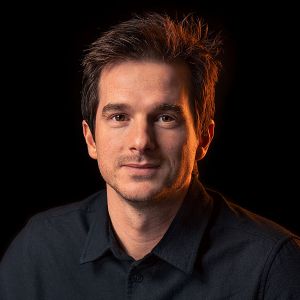
Alexandre Assouline
Alexandre Assouline is a condensed-matter physicist at Institut Néel (CNRS/UGA) specializing in quantum materials and electron-optics in graphene. His research blends precision charge-sensing thermodynamics, shot-noise spectroscopy, and surface acoustic waves to reveal microscopic degrees of freedom and transport in strongly correlated and topological phases. Recent highlights include the on-demand emission and coherent control of Levitons in graphene Mach–Zehnder interferometers, and the quantitative determination of even-denominator FQH gaps in bilayer graphene, key steps toward probing non-Abelian anyons. He was awarded a 2025 ERC Starting Grant (ANYONBOX) to engineer and study anyonic states in bilayer graphene. Earlier work demonstrated the spin–orbit–induced φ₀ phase shift in Josephson junctions.
Alexandre Assouline investigates the fundamental physics of quantum materials with an emphasis on graphene-based electron optics and strongly correlated topological phases. His lab develops and applies single-charge sensors to map chemical potential and entropy, shot-noise to extract effective charge and electronic temperature, and surface acoustic wave (SAW) techniques to interrogate quasiparticle transport in two-dimensional systems.
Assouline’s recent work established emission and coherent control of single-electron in the form of Leviton in graphene Mach–Zehnder interferometers, enabling manipulation of itinerant electronic qubits and quantifying edge-state coherence at cryogenic temperature. He also measured energy gaps of even-denominator fractional quantum Hall states in bilayer graphene by combining activated transport with direct chemical-potential measurement, consolidating this platform for exploring non-Abelian anyons. Building on a broader track record in hybrid mesoscopic systems, he previously resolved the spin–orbit induced anomalous phase shift (φ₀) in Josephson junctions, linking spin–orbit coupling to phase control in superconducting circuits.
In 2025, Assouline received a ERC Starting Grant for ANYONBOX (“Anyon box in bilayer graphene”), aimed at engineering and diagnosing confined anyonic states with gate-defined architectures. Ongoing projects integrate van der Waals assembly, cryogenic RF transport, ultrafast gating, and SAW excitations to deliver quantitative tests of fractionalization, statistics, and topological protection. The long-term goal is to turn fundamental insights on correlated physics into robust building blocks for quantum technologies